

 Lifetime Guarantee

Description
Our customers choose the FASCIQ® Small Handlebar IASTM Tool to assess tissue quality and treat specific focus areas during instrument-assisted soft tissue mobilisation. The comfortable handles help reduce strain on the hands, joints and wrists during soft tissue treatments. All FASCIQ® IASTM tools come with a Lifetime Guarantee.
All FASCIQ® IASTM tools come with a Lifetime Guarantee, which applies under normal conditions of use.

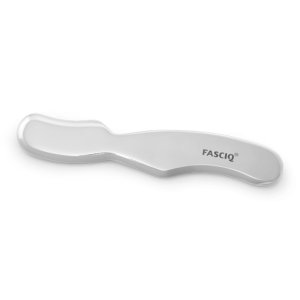
FASCIQ® Small Handlebar IASTM Tool
- Material: AISI 304 (1.4301) high-quality surgical stainless steel.
- Weight: 153 grams.
- Dimensions: 5 mm x 1 cm x 31 cm.
- Finished and checked by hand.
- Supplied with a luxury roll-up bag for storage and transport.
The FASCIQ® Small Handlebar is a long stainless-steel IASTM tool with two comfortable handles and smoothly rounded treatment edges. Its elongated shape makes it particularly suitable for controlled gliding movements across larger treatment areas and muscle groups.
The two handles provide a secure grip and allow the practitioner to guide the tool with both hands. This helps distribute pressure more evenly and reduces unnecessary strain on the fingers, thumbs and wrists during repeated or longer treatment strokes.
Comfortable two-handed grip
The handlebar design gives the practitioner greater control over the direction, speed and pressure of each movement. Using both hands can also help maintain a consistent glide through the tissue without relying on excessive force from the wrists or thumbs.
The rounded edges are suitable for broad instrument-assisted soft tissue mobilisation techniques. The long treatment surface makes the Small Handlebar a practical choice for areas such as the back, thighs, hamstrings, calves and other larger muscle groups.
FASCIQ® IASTM Tools product video
Common applications of FASCIQ® IASTM Tools
FASCIQ® IASTM tools are commonly used by trained professionals as part of treatments involving areas or complaints such as:
- Plantar fascia complaints
- Patellar tendon complaints
- Achilles tendon complaints
- Carpal tunnel syndrome
- Shin splints
- Adhesive capsulitis
- Tennis elbow and golfer’s elbow
- Iliotibial band friction syndrome
- Surgical or traumatic scars
The appropriate IASTM tool and treatment technique depend on the body area, tissue and individual situation. Instrument-assisted soft tissue treatments should be performed by a practitioner with suitable knowledge and training.
Why fascia requires attention
The fascial system is closely connected to the functioning of joints, muscles, organs and tendons. Well-hydrated fascia helps the different layers of tissue glide smoothly during movement.
Fascia also contributes to the transmission of force throughout the body. These properties make the fascial network an important consideration during soft tissue assessment and treatment.