


Taping for Medial Patellar Luxation in Dogs
Medial patellar luxation is a common developmental joint condition in which the kneecap (patella) slips out of its groove towards the inside of the leg. It occurs more often than lateral luxation and is most common in small breeds, though large breeds such as Labradors can also be affected. As the patella repeatedly rubs against the medial side of the femur, it gradually wears away the cartilage, which can lead to chronic pain and arthritis.

Popular products to tape for patellar luxation
-
VetkinTape® veterinary tape 6cm x 5m
Bestseller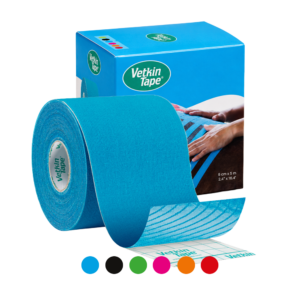 £11.95
Select options
This product has multiple variants. The options may be chosen on the product page
£11.95
Select options
This product has multiple variants. The options may be chosen on the product page
-
VetkinTape® Spray Clean Coat Pre-Taping Spray
 £9.95
Add to cart
£9.95
Add to cart
-
VetkinTape® Canine Introductory offer
 £65.00
Add to cart
£65.00
Add to cart
-
VetkinTape® Cutter – Kinesiology tape cutting device
 £69.95
Add to cart
£69.95
Add to cart
Grading and when taping helps
Patellar luxation is classified into four grades of severity. Grades I and II can often be managed conservatively, and this is where kinesiology taping is most useful: it can help create lines of tension along the sides of the trochlear groove, supporting a straighter path for the patella as the dog moves. Grades III and IV usually require surgical correction; taping does not resolve a patella that stays out of place.
- Grade I: The patella can be manually luxated but returns to place on its own.
- Grade II: The patella luxates during limb movement (extension, flexion or tibial rotation).
- Grade III: The patella sits outside the groove but can be manually reduced.
- Grade IV: The patella sits outside the groove and cannot be reduced manually.
Step-by-step application
-
Apply an “I” strip on each side of the trochlear groove to help guide the path of the patella. Since medial luxation is more common, two strips can be applied on the medial side for extra support.


- Finish with a transverse “I” strip over the patellar tendon, applied with medium tension. This can help relieve pain in the tendon, which may be under extra strain while the patella sits out of its normal position.
-
Facilitate the quadriceps muscle for extra support, since it plays an important role in keeping the patella correctly positioned. Cut a “Y” shape and apply it proximal to distal along the quadriceps, ending both tails around the trochlear groove.

-
Optional: apply quadriceps facilitation as a separate strip if you are not combining it with the groove-support strips above.

Important precautions
- Taping supports grades I–II only; it cannot correct a patella that stays out of the trochlear groove (grades III–IV).
- Have the grade of luxation confirmed by a veterinarian before deciding whether taping is appropriate or whether surgical correction is needed.
- Check the skin is clean, dry and free of irritation before applying tape.
More information:
Please note that applications provided on our website are not clinically proven. All mentioned applications are based on extensive evaluation and case studies with licensed veterinarians and/or canine physiotherapists. Always have the underlying cause of lameness diagnosed by a veterinarian before applying tape.
Attention: Mentioning source is mandatory, when using the content on this page.